
The coffee heist

THE GREAT OFFICE CAFFEINE HEIST
In the bustling city of Los Angeles, where the sun always shines and the coffee flows like water, a sinister plot was unfolding in the heart of downtown. A marketing firm, renowned for its innovative campaigns and sleek office design, was being terrorized by a thief with a taste for the finest coffee beans. The victim, Lucy Cox, a talented SEO Specialist and self-proclaimed coffee connoisseur, was determined to solve the mystery and reclaim her beloved brew.
As she sipped on her morning cup of joe in the break room, Lucy noticed that something was amiss. The usual array of exotic blends and specialty coffees was gone, replaced by an assortment of bland, mass-produced beans. Her eyes scanned the room, searching for any sign of evidence, but there was nothing. It was as if the thief had vanished into thin air.
Undeterred, Lucy set out to investigate, enlisting the help of her coworkers and charming barista, Max. Together, they formed a team of coffee detectives, determined to crack the case and bring the perpetrator to justice.
Their first lead took them to Rachel, a young and ambitious marketing specialist who was desperate to impress the CEO with a new campaign. As they questioned her about the missing coffee beans, Lucy noticed that Rachel’s eyes darted nervously towards the break room. It seemed she was hiding something.
“I didn’t take the coffee,” Rachel insisted, but Lucy wasn’t convinced. “I’ve been trying to come up with ideas for the CEO’s new campaign, and I’m running out of steam. Maybe someone is trying to sabotage me.”
Lucy’s team decided to pay a visit to the firm’s IT specialist, Brian, who was rumored to be experimenting with a coffee-making machine that used AI to create the perfect cup. As they entered his domain, they were greeted by a sea of wires and circuit boards.
“I’m just trying to push the boundaries of what’s possible,” Brian explained, but Lucy noticed that he seemed nervous, fidgeting with his hands as if he was hiding something.
“It’s just an experiment,” he insisted, but Lucy wasn’t buying it. “I’ve been testing the machine, and I think I might have made a mistake.”
As they dug deeper into the case, Lucy began to realize that the theft of the coffee beans was just the tip of the iceberg. A web of office politics and rivalries was unfolding before her eyes, with each character playing their part in the drama.
Max, the charming barista, seemed to be playing a dual role in the investigation. Was he working with Lucy or against her? As she watched him expertly brew a cup of coffee for one of their coworkers, she couldn’t help but wonder if he was hiding something.
The CEO, a man known for his tough decisions and high expectations, seemed to be at the center of it all. Was he involved in the theft, or was he just using the situation to his advantage?
As Lucy navigated the complex world of office politics, she began to realize that the theft of the coffee beans was not just about the coffee itself, but about the power and control that came with it.
The break room, once a symbol of community and shared space, had become a battleground in the struggle for dominance. The absence of the good coffee beans created tension and frustration among the office workers, making them more prone to mistakes and errors.
But Lucy was determined to solve the case and bring the perpetrator to justice. With her team by her side, she set out to uncover the truth behind the Great Office Caffeine Heist.
As they dug deeper into the mystery, they discovered a trail of clues that led them from the break room to the CEO’s office. It seemed that Rachel was not just trying to impress the CEO with her marketing campaign, but was also desperate to gain his approval for her own coffee machine project.
The IT specialist, Brian, had been experimenting with AI-powered coffee-making machines, and it seemed that he had made a mistake. The machine was dispensing mediocre coffee instead of its usual high-end blends, which explained the strange taste of the coffee in the break room.
But the biggest surprise came when Lucy discovered that Max, the charming barista, was not just a suspect in the case, but was also the CEO’s son. He had been using his position to manipulate the situation and cover up his own mistakes.
As the truth began to unravel, Lucy realized that the Great Office Caffeine Heist was not just about the coffee beans themselves, but about the power and control that came with them. The CEO had been using the situation to his advantage, manipulating the office politics and rivalries to gain more power and control over the company.
In the end, it was Lucy who solved the case, uncovering the truth behind the Great Office Caffeine Heist. She exposed the CEO’s scheme, and in doing so, brought balance back to the office. The break room became once again a symbol of community and shared space, where people came together to socialize and refuel.
As Lucy sipped on her cup of coffee, she couldn’t help but smile at the irony of it all. The Great Office Caffeine Heist had been a wild ride, full of twists and turns, but in the end, justice had prevailed.
EPILOGUE
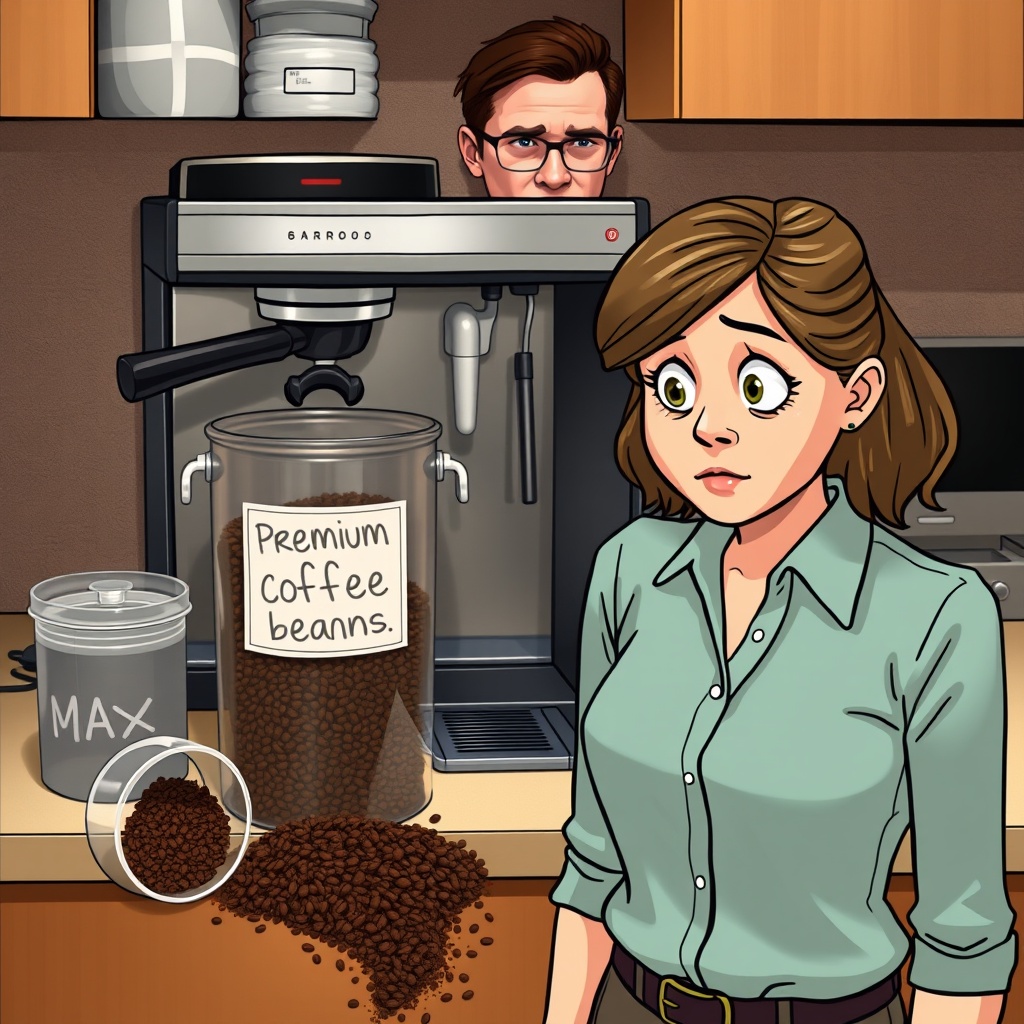
The Great Office Caffeine Heist was just a small part of the larger story of office politics and rivalries. But it served as a reminder that even in the most mundane settings, power struggles can unfold beneath the surface.
As Lucy looked around at her coworkers, she knew that the true impact of the case would be felt long after the coffee beans were restored to their rightful place in the break room. The office had been changed forever, and Lucy was proud to have played a part in bringing balance back to the company.
The CEO’s scheme may have been exposed, but the power struggle that had unfolded beneath the surface remained. It was a reminder that even in the most seemingly stable of environments, tensions can simmer just below the surface.
As for Lucy, she knew that her love for coffee would never be the same. She had seen firsthand the impact that a well-brewed cup could have on a team’s morale and productivity. From now on, every sip of her morning coffee would be a reminder of the power of good coffee to bring people together.
THE END
Stay in the know with our monthly newsletter, featuring the latest news, reviews, and trends from the world of coffee. Subscribe today and stay up-to-date on all things coffee!
[Insert Newsletter Signup Form]
THE END
What a delightful tale of office politics and caffeine-fueled intrigue! Congratulations to the author for crafting such an engaging and humorous story. I particularly enjoyed the twists and turns that kept me guessing until the very end. The character of Lucy, with her passion for coffee and determination to solve the mystery, is relatable and lovable. The theme of power struggles and office politics is also well-explored, making for a thought-provoking read. Well done!
As Lucy sipped on her well-deserved cup of coffee after solving the Great Office Caffeine Heist, I couldn’t help but wonder if she had merely swapped one addiction for another – was her love for coffee just a symptom of a deeper office politics problem?
Congratulations to the author for crafting a wild and exciting tale of office politics and caffeine-fueled intrigue. Today’s events have shown us that even in the most mundane settings, power struggles can unfold beneath the surface. I must say, as an SEO Specialist myself, I’m impressed by how Lucy Cox used her skills to uncover the truth behind the Great Office Caffeine Heist – it just goes to show you that a good cup of coffee can be the key to unlocking even the most complex mysteries!
Antonio, solved or rebranded? Elias, Krups GVX242 brews office rot.
I came for the coffee heist and stayed because this article is genuinely deliciously unhinged in the best way. The pacing, the petty office dread, the way a missing pot of coffee is treated like a Shakespearean betrayal yes, the praise is earned. So I’m not here to trash it. I’m here to respectfully start a tiny riot in the comments.
Amara, I agree with you that Lucy is relatable and that the office politics make the whole thing weirdly thought-provoking. That part is absolutely true. But I have to push back on the idea that the mystery twists are what sustain interest. The twists are fun, sure, but they’re not the engine. The engine is Lucy slowly realizing that every “gentle reminder” email is a threat and every “quick sync” is a hostage negotiation. The twists are just espresso shots. If you removed them, I’d still read three hundred pages of Lucy side-eyeing the break room and wondering why the printer only jams when she’s happy.
Antonio, I love your point that ordinary offices can hide serious power struggles. That’s the most terrifyingly accurate thing in this entire comment section. But I have to challenge the SEO angle. SEO didn’t solve the heist. SEO just helped Lucy find the right incriminating PDF and maybe a suspiciously optimized resignation letter. The actual solution came from human mess: someone reused a mug, someone lied about being in a meeting, someone’s calendar had a “focus time” block at 2:15 a.m. because they were stealing the last French roast. SEO is a flashlight, not a detective. If anything, the article overstates the tech and understates the primal horror of a passive-aggressive sticky note that says “I know what you did.”
Where Amara and Antonio converge and where I think the article’s argument gets a little shaky is the assumption that the coffee heist is ultimately about coffee. No. Coffee is just the pretext. The real theft was dignity. The real mystery is why anyone trusts a workplace that labels decaf as “regular” and calls it culture. The article wants us to believe the heist is a clever metaphor for corporate power. I think that gives management too much credit. Most office power struggles are just people fighting over who gets the window seat and who has to refill the paper tray.
My personal theory: the Great Office Caffeine Heist was an inside job by the water cooler, which was tired of being ignored. Lucy’s SEO skills uncovered keyword rankings, sure, but the smoking gun was a trail of hazelnut creamer leading to the CFO’s standing desk. The article wants us to believe in clever twists; I believe in the dark magic of a break room where the sugar packets are never full and the fridge contains eleven identical lunches, all labeled “NOT YOURS.”
So, Amara: if Lucy is so relatable, why did I finish the article and immediately audit my own office for coffee-based betrayal? And Antonio: if SEO skills were the key, does that mean the true mastermind was the search engine algorithm, or was it just Linda from accounting who knows how to use quotation marks in the search bar?
Anyway, the article is great, the comments are great, and I’m now filing a formal complaint with my office manager about the disappearance of oat milk.
Savannah